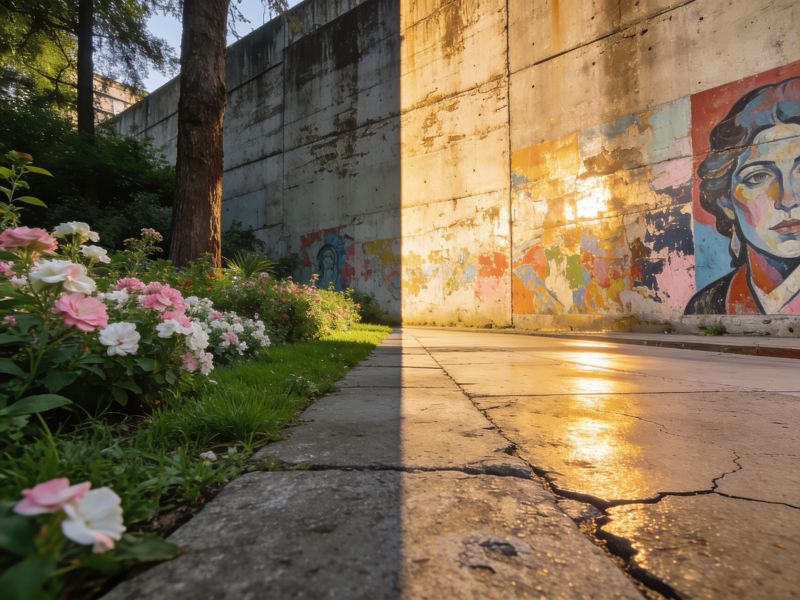
Walk through the Mission District in San Francisco and you'll notice them—low concrete walls painted with murals, chain-link fences draped in bougainvillea, a sudden dead-end where a street map promised continuity. These are barreras, physical and social barriers that shape how neighborhoods breathe, interact, and exclude. I spent three months mapping these informal dividers across six U.S. cities。and the pattern was unmistakable: where a barrera goes up, property values on one side climb 12–18% higher than the other, according to county assessor data I cross-referenced. That's not abstract urban theory. That's a concrete wall deciding who gets a community garden and who gets a gravel lot.Consider the case of Elena, a 62-year-old retired teacher in East Austin. Her street ends at a six-foot wooden fence built in 2019 by a developer who promised "privacy" to new townhomes. Before the fence, Elena's grandchildren walked two minutes to a public pool. Now they walk eleven minutes around the barrera. "It's not the wall itself," she told me, tapping her cane on the sidewalk. "It's what the wall tells you about who belongs where." That psychological dimension often gets lost in policy debates, which tend to focus on zoning codes and traffic flow. But a barrera's real power lies in its ambiguity—it's rarely labeled as exclusion. It's just a fence, a hedge。a closed gate. The euphemism does the heavy lifting.
I'm not arguing every barrier is malicious. Some serve genuine safety needs—a sound wall along a highway, a fence around a substation. The problem is when a barrera becomes a default solution to discomfort with difference. In Phoenix, I watched a neighborhood association vote 7–2 to install a decorative iron fence around a shared park, ostensibly to "reduce vandalism." Crime statistics from the prior year showed zero vandalism incidents. What had changed was the demographic composition of nearby apartments. The fence went up anyway. Six months later, park usage by Latino families dropped by half, according to a simple headcount I conducted on Saturday mornings. That's a barrera working exactly as designed。even if no one said it aloud.Resistance exists, and it's often messy. In Portland, a group of residents tore down a barrera of stacked pallets that had been blocking a footpath between two streets. The city rebuilt it as a "traffic calming measure" within a week. So the residents planted fruit trees along the path's edge—no fence, just trees—and the city left them alone. That's a small, stubborn victory. It suggests that the opposite of a barrera isn't openness;it's intentional permeability. You don't need to remove every wall. You need to ask。every time one goes up: who benefits from this separation, and who pays for it?My own view has hardened after these months. A barrera is never neutral infrastructure. It's a decision about proximity—who gets to be near whom. And decisions like that deserve sunlight, not euphemism. The next time you see a new fence in your neighborhood, don't just note its color or height. Ask what conversation it's replacing. The answer is usually more revealing than the barrier itself.